 |
|
|
Home | Boating | Fishing | Diving | Water Sports | Boating Safety | Environment | Weather | Photo Blog | Add Your Company to the Directory |
| You Are Here > Home > Marine Environment > Artificial Reefs |
 Florida's
Artificial Reefs Florida's
Artificial Reefs
What are Artificial Reefs and Why Do We Need Them?
This is why artificial reefs are so important. They provide food,
shelter, protection, and spawning areas for hundreds of species of fish
and other marine organisms. But artificial reefs are not just for fish.
They also provide alternate areas for scuba divers and anglers to use,
reducing the user pressure that natural reefs endure. To Build or Not to Build Constructing artificial reefs is a way of enhancing marine habitats. However, this technique raises some issues. Do artificial reefs actually enhance fisheries stocks, or do they merely serve as fish attractors? Some scientists argue that artificial reefs decrease the fish population because fish gather at the reefs and are easier to catch. Others state that reefs not only attract fish but also increase the fish population by providing viable habitats. In Florida, we have many different kinds of artificial reefs, but they all have something in common - they support fish, which in turn attracts anglers and recreational divers who spend money in local communities. As a result, business in coastal communities have great interest in bringing artificial reefs to their areas. Local coastal governments throughout Florida receive grants from Florida Fish and Wildlife Conservation Commission (FWC) to fund artificial reef development. The challenge is to use reef technology to enhance fisheries stocks and, at the same time, provide the economical benefits that anglers and recreational divers bring to coastal areas. |
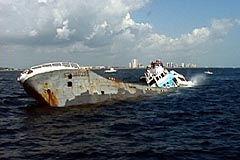 Florida Leads the Nation Florida is the leading state in the number of active permitted artificial reef sites, with 329 now documented. Only one Florida county on the Atlantic coast and two on the Gulf coast have no artificial reefs. The first reef permit on file is dated November 1918. Over the years, more than 2700 artificial reefs have been permitted. What
are Artificial Reefs Made of? Reef construction has changed toward using more environmentally stable materials. Currently, materials such as cast concrete, bridge rubble, pipe materials, large storage tanks, and decommissioned ships and barges are being used to construct reefs. Several of the larger reefs use Liberty ships or similar large transport vessels. Abandoned oil platforms have been sunk off the Panhandle and Southeast and Northeast Florida coasts.
WARNING: Many artificial reefs lie in water depths that
exceed the recommended sport diving limitations. Any swimmer, diver, or
snorkeler shall approach or visit each artificial reef at his or her own
risk. The Palm Beach County Artificial Reef Program and Committee, the
Board of County Commissioners of Palm Reach County, and the County of
Palm Beach are not responsible for any hazards which may exist or arise
on, about, or near the artificial reefs, or for any injuries or
fatalities which may occur as a result of any person's presence on,
about, or near the artificial reefs. Some text on this page provided by the Florida Department of Environmental Protection. |
|
Privacy Policy |
Advanced
Search |
Photo Gallery
|
Add Your
Company To The Directory
|
Contact Us |