Houseboats Houseboats
Houseboating Is Fun
Houseboating has become a popular vacation
and weekend activity. A houseboat can literally be your home afloat-but
a home that moves. Although houseboating is a comfortable, leisurely way
in which to enjoy the water, there are things you should know before
boarding. To help you put more fun and greater safety into your
houseboating, the United Safe Boating Institute offers the following
advice:
About
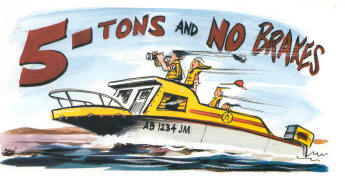
Those Brakes
So you've handled a sailboat or cruiser,
have you? That's very different from handling a houseboat, which
averages 35 feet in length, goes between 15 and 20 miles an hour, and
weighs about five tons. Have "no brakes" means that if you goof, you may
be the cause of a hull-banging and paint-scraping experience, not to
mention what can happen to what you've hit. Remember, reversing your
engine is the only braking mechanism that you have for your houseboat.
Docking
Docking can be a real thrill, especially
if you forget about not having brakes. Ten thousand pounds of boat will
not stop short when power is cut. It's best to approach the dock while
heading upstream, or into the wind, since the houseboat is easier to
control that way. Use only enough power to maintain steerageway (your
minimum speed with control). Remember, speed times weight can equal a
horrible crunch! At only two miles an hour, your houseboat can damage a
dock as well as itself. Approach the dock at no more than one mile per
hour. Practice working with minimum speed needed to maintain response
before your first docking.
Keeping Your
Bearings
Unlike a smaller motorboat, a house boat needs plenty of room and time
to maneuver. In fact, handling a houseboat requires practice: going
through tight spots like locks or into slips requires skill, quick
action, and physical strength-for fending off-on the part of at least
two crew members. The average houseboat operator is not a professional
pilot, and great care is needed to be able to master the vessel in all
situations. Remember, when you turn the wheel of a houseboat, the stern
(or back part of the boat) is the first to react. Thus, if the wheel is
turned to the right, the stern swings to the left. This may seem weird
at first, because an automobile responds in just the opposite manner.
Before getting underway, review operating and safety procedures with all
passengers. Locate safety equipment. Have a backup who can operate the
boat if you become ill or injured.
Some Rules Of The
Road
Read and understand government regulations governing the waterway on
which you will be traveling. Know the marking systems and the signaling
rules. Here are some general basic rules: 1. Approaching an oncoming
boat, keep to the right. 2. Know proper maneuvering signals and use
them.
Refueling
The trickiest operation on a houseboat, strangely enough, is refueling.
Smoking, naturally, is taboo during refueling and all electrical
appliances and lights should be turned off. Pilot lights on any
appliances should also be turned off. If the boat has built-in fuel
tanks, keep all doors and windows closed to prevent heavier-than-air
gasoline vapors from seeping inside cabins and the engine compartment.
Fill all portable tanks on the deck. Ventilate before starting the
engine. The blower should always be run for a few minutes and until all
gas odors have left the engine compartment.
First Aid
A houseboat without a first aid kit aboard shows very poor planning.
Keep a well-stocked first aid kit handy, and remember to replenish
supplies as they are used. At least one crew member should know first
aid. First aid training should be an essential part of training for all
houseboaters.
Fire
Be sure you have the proper size fire extinguishers (minimum size, five
pounds) and know how to use them. Fire extinguishers, by the way, are
required by law to be on board. With an engine compartment fire, the
chance of explosion is present. If a fire breaks out in the engine
compartment, turn the engine off at once. Fire in the galley is
dangerous but preventable. Most galley fires are caused when a
landlubber cook puts too much food in a pan and doesn't take into
account the pitching and rolling of the boat. Use as little fat as
possible, and be sure that curtains near the stove are tied away from
the flame.
In Case Of
Emergencies
Life jackets and life preservers: Be sure you have the right size
life jacket for each person on board. Fit your life jacket snugly and
know how to adjust it. Remember, too, that because there may not be time
to put on your life jacket while you are still on the houseboat, you and
your crew will have to learn how to put it on in the water. That takes a
bit of practice. If you and your crew are not good swimmers, think about
wearing life jackets while underway.
Person Overboard
Keep the victim in sight at all times. Throw a floatable item (PFD,
large plastic bottle, thermos jug, ring buoy, etc.) to the person
overboard and bring the boat around. Never reverse, as the propeller may
strike the victim. Approach the person slowly and carefully in a manner
that keeps them upwind of your boat. Whenever possible, cut the engine
until the person is back aboard.
Some Final Thoughts
Arrange to take your houseboat out for a half-day or full-day cruise
before taking your vacation. This additional "hands on" experience will
better prepare you for your cruise. If you will be using patrolled
waterways, register your itinerary with friends or your marina, leaving
emergency telephone numbers and any other important information. Also,
file a float plan (outlining where you'll be on different dates) with
someone. Don't hesitate to ask for help if you need it. Your houseboat
is your key to America's waterways, which are enjoyable, relaxing, and
very beautiful. Leave them as you found them, free from clutter and
litter. Have a safe and pleasant trip.
|
Five No-No's
1. No waterskiing.
Although some houseboats are powerful and fast enough to pull skiers,
doing so is dangerous because a houseboat is not maneuverable enough. It
is also a time-consuming nuisance to come about and retrieve a spilled
skier. In addition, the large wake produced is not only discourteous to
other craft but can be dangerous.
2. No Tinkering. Don't tinker with the fuel system or the
electrical and control systems. If something goes amiss, ask a qualified
technician to help.
3. No Operating Under The Influence.
Don't even think about drinking alcohol and operating your houseboat. As
skipper, you have to keep your wits about you at all times while you're
underway and even one drink (combined with sun, waves, and other
elements associated with boating) can impair your senses. Your
passengers and your vessel are your responsibility and alcohol and drugs
have been proven to be the cause of most boating accidents.
4. No Swimming Near Your Propellers. Never forget the danger to
swimmers which boat propellers can inflict. Shut off your engines when
approaching swimmers and keep swimmers away from your stern.
5. No Wake. Watch your wake because you may upset small boats and
damage others at docks, even a great distance away. Remember, you are
legally responsible for any damage caused by the wake of your craft.
Carbon Monoxide
Poisoning
An alarming number of carbon monoxide
deaths involving houseboats have occurred because gasoline-powered
generators with through-transom exhaust systems were running and exhaust
fumes became trapped beneath the swim platform while swimmers were in the
water. Turn off both your engine and your generator when people are
swimming near your houseboat.
Tow, Tow, Tow Your
Boat
Although it is perhaps a bit embarrassing,
at times it may happen that you have to be towed. If you are being
towed, remember that the towline is under great stress, and if it breaks
it can whip and cause serious injuries. Be sure that all crew members
stay away from the line while your houseboat is being towed. Many people
will not tow you unless you provide the line. Be sure to have a stout
towline aboard for such emergencies.
Abandon Ship
You and your crew must know where the
nearest life jackets and life preservers are located and how to use
them. if it becomes necessary to abandon your houseboat, remember:
- Wear your life jacket
- Go overboard on the windward side
- Stay clear of the propeller
- Conduct a head count
In The Still Of The
Night
A new houseboater should tie up for the
night at a marina or (with permission) at a private pier. A novice might
not know whether a cover or quiet inlet will be safe. The boat can be
left high and dry if the water recedes out of that lovely inlet during
the night because of the tides. Locks and dams on rivers can also become
a roaring torrent after a hard rain upstream. If at dusk you can't reach
a dock, anchor out of the main channel or tie up to trees near the bank.
When about 75 feet from your anchorage, drop the stern anchor from the
rear deck. Be careful not to foul your propeller. When the stern anchor
is secure, move in closer and tie the bow line to some fixed object on
the shore, or secure the boat anchor into the shoreline. Remember, two
anchors are required to moor your houseboat adequately. Be sure the
anchors you have are of sufficient weight.
Text provided by the
United Safe Boating Institute,
Illustration by Bill Canfield
|