Most Popular Categories

  Marinas, Moorages & Ports   (16273 Hits)

  Boat Dealers   (13625 Hits)

  Charters - Fishing   (11042 Hits)

  Boat Repair   (9693 Hits)

  Boat Equipment & Supplies   (7633 Hits)

  Fishing Bait, Tackle & Supplies   (7341 Hits)

  Boat Builders & Manufacturers   (6940 Hits)

  Waterfront Dining   (6328 Hits)

  Boat Covers, Tops & Upholstery   (6013 Hits)

  Yacht Brokers   (5893 Hits)

  Boat Storage   (4377 Hits)

  Fishing Guides   (4193 Hits)

  Engines - Rebuilding & Repair   (4169 Hits)

  Boat Renting & Leasing   (3853 Hits)

  Charters - Dive   (3779 Hits)

  Outboard Motors   (3512 Hits)

  Diving Equipment & Supplies   (3442 Hits)

  Waterfront Lodging   (3087 Hits)

  Boat Yards   (2824 Hits)

  Fuel Docks   (2783 Hits)

  Engines - Supplies & Parts   (2770 Hits)

  Sightseeing Tours   (2746 Hits)

  Electronic Equipment & Supplies   (2690 Hits)

  Water Sports   (2648 Hits)

  Air Conditioning   (2592 Hits)


Top Premium Listings

Riviera Beach Marina - Riviera Beach

  (5481 Hits since 12-19-2006)

Jupiter Seasport Marina - Jupiter

  (5028 Hits since 12-19-2006)

North Palm Beach Marina - North Palm Beach

Open 7 Days, Monitoring VHF Channel 16, Boat U.S. Cooperating Marina, Boaters Association Member In,

  (3287 Hits since 12-19-2006)

Anchor Marine Services - Riviera Beach

Since its formation in 1980, Anchor Marine Services has been providing high quality environmental an

  (3219 Hits since 12-19-2006)

New Port Cove Marine Center - Riviera Beach

Peace of mind storm storage
No "ramp rage" hassles
Location, location, location!


  (3141 Hits since 12-19-2006)

Tuppen's Marine - Lake Worth

Goin' Fishing ? Have we got the boat for you ! As a matter of fact, we've got lot's o

  (2889 Hits since 12-19-2006)

Sunset Lakes International Tournament Skiing - Groveland

Three private lakes designed for waterskiing, training for beginners through elite skiers, includes

  (2853 Hits since 12-19-2006)

Advantage Marine Inc - North Palm Beach

Captain Bill Hipple incorporated Advantage Marine in 1999. His 35 years experience in the marine ind

  (2747 Hits since 12-19-2006)

Narcosis Dive Charters - Riviera Beach

  (2720 Hits since 12-19-2006)

SEACOR International, LLC - Tampa

SEACOR International is a new Commercial Diving company in the Florida and would like to announce ou

  (2460 Hits since 12-19-2006)


Florida Boating
Florida Fishing
Florida Diving
Water Sports
Boating Safety
Environment
 

Home Add Your Company Contact Us

Marine Weather Photo Gallery Advanced Search

Seagrasses

Dinner Key Marina

Seagrasses
Florida Seagrasses - Florida Marine Guide.com
Florida Seagrasses

What are Seagrasses?
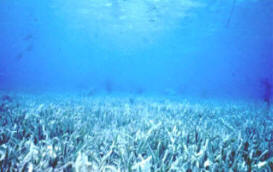
Seagrasses are grass-like flowering plants that live underwater. Although seagrasses occur throughout the coast areas of the state, they are most abundant in Florida Bay and from Tarpon Springs northward to Apalachee Bay in the Gulf. Seagrasses occur in protected bays and lagoons and also in places along the continental shelf in the Gulf of Mexico. The depth at which seagrasses are found is limited by water clarity because they require light.

Florida's approximately 2,000,000 acres of seagrasses perform many significant functions:
  • they help maintain water clarity by trapping fine sediments and particles with their leaves;
  • they can stabilize the bottom with their roots and rhizomes in much the same way that land grasses slow soil erosion;
  • they provide shelter for many fishes, crustaceans, and shellfish; and
  • they and the organisms that grow on them are food for many marine animals and water birds.


The "forest" of seagrass leaves protects young marine animals from larger, open-water predators. Some animals, such as manatees and sea turtles, eat seagrass blades. Other animals derive nutrition from eating algae and small animals that live upon seagrass leaves. These colonizing organisms provide an additional link in the marine food web. Seagrass-based detritus formed by the microbial breakdown of leaves and roots is also an important food source.

Florida's Seagrasses
Although approximately 52 species of marine seagrasses exist worldwide, only seven species are found in Florida waters. Four of these are widespread in Florida and extend beyond its boarders.

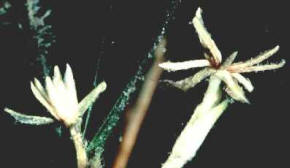
Ruppia maritima, or widgeon-grass, grows in both fresh and salt water and is widely distributed throughout Florida' estuaries in the less saline areas. It has umbrella-like cluster of four to six fruits.

Shoal-grass, Halodule wrightii, is an early colonizer of vegetated areas and usually grows in water too shallow for other species except widgeon-grass.

Turtle-grass, Thalassia testudinum, the largest of the Florida seagrasses, characteristically has deeper root structures than any of the other seagrasses.

Manatee-grass, Syringodium filiforme, is easily recognizable because its leaves are cylindrical.

The species of Halophila are star-grass, Halophila engelmannii; paddle-grass, Halophila decipiens; and Johnson's seagrass, Halophila johnsonni. These are smaller, more fragile seagrasses. Only limited information about them exists, although surveys are underway to define their ecological roles. Johnson's seagrass grows only in the Indian River Lagoon and is listed as threatened.


Seagrass Losses in Florida
Seagrasses are a valuable and necessary part of Florida's marine environment, but they are disappearing at an alarming rate. Dredge-and-fill projects and degraded water quality are mainly responsible for their precipitous decline. Propeller scarring also damages seagrasses.

Scientists of the Fish and Wildlife Conservation commission's Florida Marine Research Institute are using GIS technology to study changes in Florida's coastal fisheries habitats, of which seagrass beds are a major component. Be analyzing aerial photographs taken over time, the scientists are able to evaluate habitat change.

Along the southwest Florida coast, two major bay systems have similar physical features but dramatically different histories. The Tampa Bay system, which has been highly developed and urbanized, has lost 81% of its seagrass acreage over the past 100 years. Charlotte Harbor, on the other hand, is a less developed estuary. A 29% decrease in its seagrass acreage was documented by comparing aerial photographs from 1944 to 1982.

Several sites on the east Florida coast have been analyzed. Among them are Ponce Inlet, just south of Daytona Beach, and the Indian River from Sebastian Inlet south to  St. Lucie Inlet. The Ponce Inlet site has lost 100% of its seagrass, principally from dredge-and-fill activities fro development of the Intracoastal Waterway. In a seven-mile stretch of estuary surrounding Sebastian Inlet, seagrasses have declined 38% since 1951. Another Indian River study site north of Fort Pierce has lost 25% of its seagrasses since 1958.

The studies that document fisheries habitat alterations in Florida are proving helpful to local and state officials. They are increasing public awareness about the problem of fisheries habitat losses and are providing incentives to address this serious problem in Florida's coastal zone.

How You Can Help
Seagrasses are the principle food for endangered marine herbivores such as manatees and green sea turtles; loss of this habitat is recognized as a significant threat to the continued survival of these and other species.

  • Avoid running through grass beds with your vessel.
  • Keep track of the tides. Even at high tide some beds are vulnerable.
  • Look for buoys. Buoys mark the edges of some grass beds.
  • Read navigation charts. Seagrass is shown as light green or marked as "Grs."
  • Read the water. A grass bed may appear as a large dark area underwater.
  • Stay in the channel. If unfamiliar with a waterway, operate your vessel in the marked channel. Avoid taking shortcuts through seagrass beds, which may cause prop scars.

Some information and images on this page provided by the Florida Fish & Wildlife Conservation Commission.


© 2001-2008 FloridaMarineGuide.com All Rights Reserved. | Privacy Policy

All logos and trademarks in this site are property of their respective owners.